
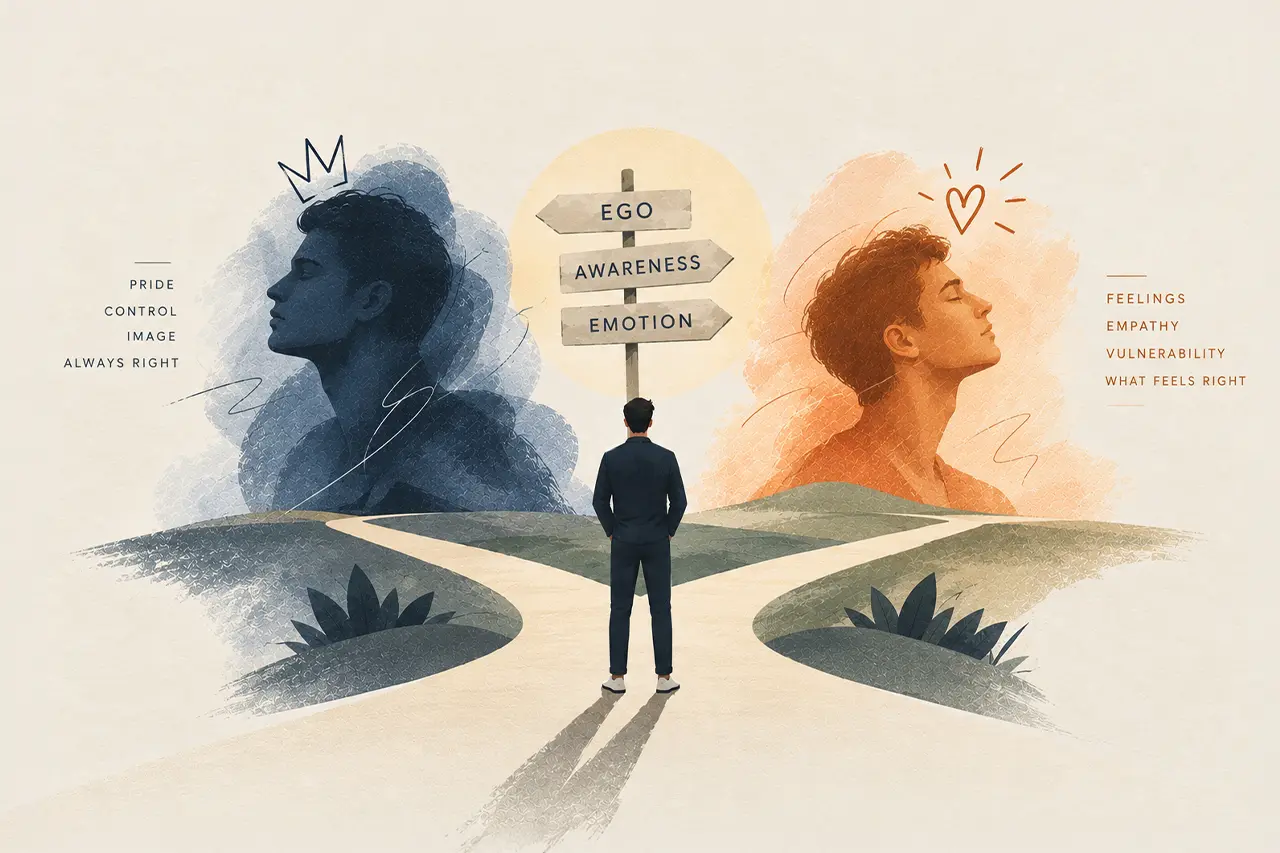
We often use the word ego quite casually.
“He has a big ego.”
“She is too full of herself.”
We usually associate ego with arrogance or an exaggerated sense of self-importance.
But ego is much more subtle.
The ego is the idea we have about who we are.
Over time, we build an identity for ourselves.
I am intelligent.
I am successful.
I am respected.
I am experienced.
I am a good person.
I am a leader.
There is nothing wrong with having an identity. We need one to navigate the world.
The problem begins when we become attached to that identity and start believing that it is who we truly are.
Then we begin protecting it.
That is where the ego enters.
When the ego takes over
Imagine somebody makes a negative comment about you.
The comment itself is just information. You could listen and ask:
Is there something useful here?
But sometimes our immediate reaction is:
How can he say that about me?
Why did a simple comment create such a strong emotion?
Because it may have touched our identity.
If I believe I am a very capable person, someone questioning my capability can feel like they are questioning me.
The ego says:
Defend yourself.
Then comes the emotion anger, hurt, irritation or disappointment.
And now our thinking is no longer completely free.
The ego has entered the decision-making process.
The chain is surprisingly simple:
Something happens → it touches our identity → the ego reacts → emotion follows → our thinking gets coloured → we make a decision.
The danger is that we usually notice only the last part.
We think, I am angry, therefore I must respond.
We don’t stop and ask:
Why am I angry?
Has something actually gone wrong, or has something touched the image I have of myself?
Success can make it harder to see
Ego is not limited to arrogant people.
Success can actually make the ego more difficult to recognise.
We achieve something. People appreciate us. We receive recognition. Our position becomes important. People listen when we speak.
Slowly, we can begin to confuse our achievements with who we are.
We are no longer simply someone who has achieved something.
We begin to think:
“I am a successful person.”
Then criticism, failure or disagreement can feel like a threat to our identity.
The ego doesn’t always say, “I am better than everyone.”
Sometimes it simply says:
“I must be right.”
And sometimes we would rather defend our position than admit that somebody else has a better idea.
That is when ego can make us miss opportunities to learn, change and grow.
So, should we get rid of the ego?
No. Try!! You cannot.
We need ambition. We need confidence. We need identity. We need to stand up for ourselves.
The objective is not to destroy the ego.
It is to become aware of it.
The next time somebody criticises you, disagrees with you or says something you don’t like, pause for a few seconds and ask:
“Am I responding to what happened, or am I defending the person I believe I am?”
That small question can change the quality of our response.
Because once we can see the ego operating, we don’t have to obey it.
We can accept criticism without feeling diminished.
We can accept that somebody else is right without feeling smaller.
We can change our mind without feeling that we have lost.
And we can fail without believing that we are a failure.
Perhaps that is the real freedom.
The ego wants to be right. Awareness wants to understand.
The ego will always be there.
The question is whether we can recognise it before it starts making decisions on our behalf.
But this isn’t something we are ever going to perfect.
We are human beings. We will get carried away. We will react. We will defend ourselves. We will sometimes allow our ego to take over without even realising it.
Perhaps the challenge is simply to become better at recognising it.
Maybe we manage it 50% of the time. The other 50%, we may not even realise what happened. And perhaps that is okay.
Because this is not a destination. It is a constant evolution.
As we grow older, perhaps we become a little better at it. As experience becomes wisdom, we begin to understand ourselves a little more. We depend a little less on intelligence alone and a little more on judgement, perspective and wisdom.
We become more comfortable saying, “I don’t know.”
More comfortable saying, “I was wrong.”
More comfortable allowing someone else to be right.
And perhaps, slowly, we learn to hold our identity a little more lightly.
We will never completely rise above the ego.
But maybe we don’t have to.
Maybe the real achievement is simply to become aware of it a little more often and to let wisdom win a little more often than it did yesterday.