
I distinctly remember the day I wrote my final engineering examination.
Like most young graduates, I walked out of the examination hall believing that life was finally about to begin. The results would take another couple of months to arrive and, while waiting for them, my friends and I continued our usual ritual of meeting in the evenings and discussing our plans. Those conversations revolved around jobs, salaries, cities, and careers. Like every young man standing at the threshold of adult life, I believed that success would largely be determined by making the right decisions.
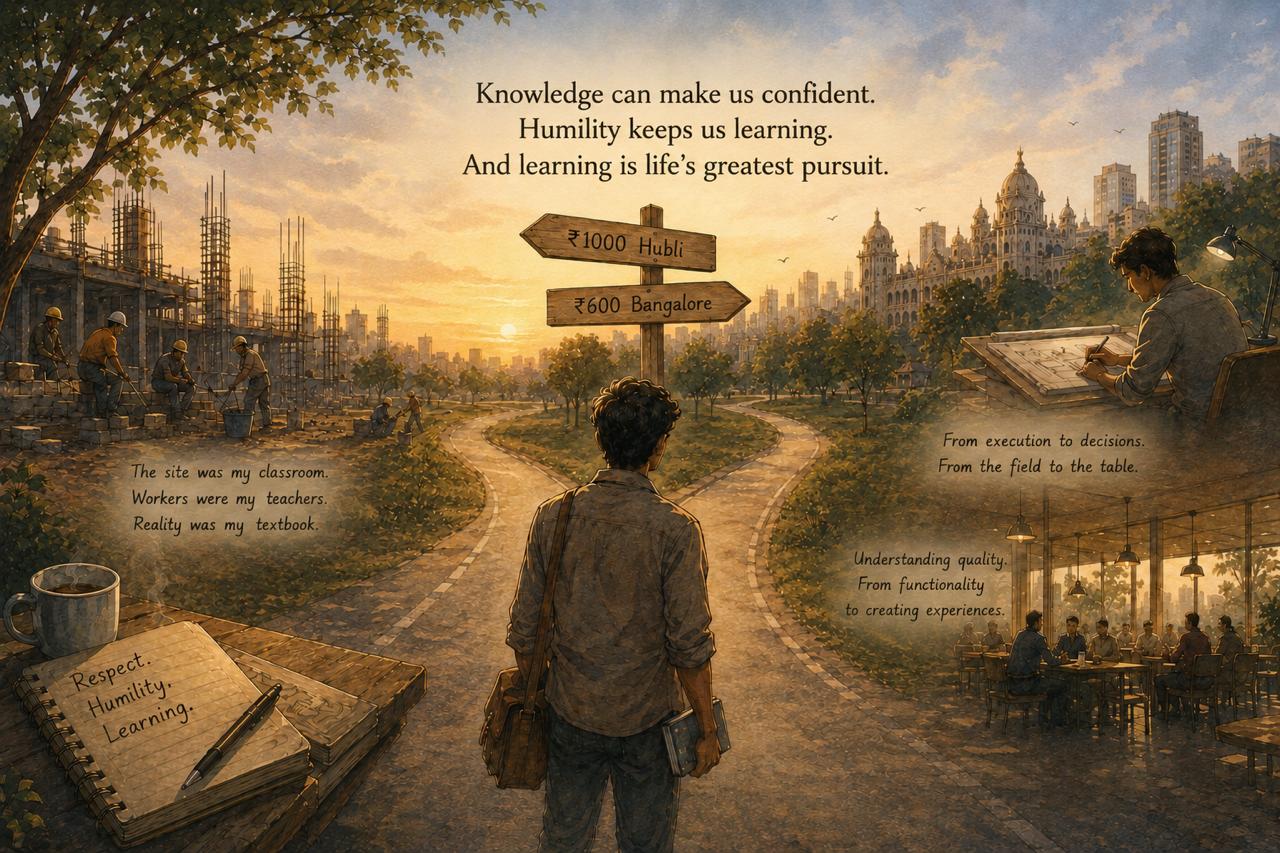
One evening, I mentioned that I had been offered a job in Hubli. A contractor building dams in North Karnataka was willing to pay me ₹1,000 a month. For a newly graduated engineer, it seemed like a perfectly sensible beginning. One of my closest friends listened quietly and then said something that changed the direction of my life.
“People come from Hubli to Bangalore looking for opportunities,” he said. “And you are leaving Bangalore to go to Hubli. I thought you were the smart one.”
His words unsettled me. Until that moment, I had approached the decision in a purely logical way. There was a job, there was a salary and there was a career path. My friend, however, saw the world differently. He had already started a small contracting business and was working on restoration projects, including work at the Bangalore Club. He offered me ₹600 a month to stay back in Bangalore and help him manage measurements, billing, documentation, and site coordination.
Looking back, it is astonishing how often the most important decisions in life appear irrational at the time we make them. If someone had shown me a spreadsheet comparing ₹600 and ₹1,000, the answer would have been obvious. Yet life is rarely governed by spreadsheets. Sometimes it is governed by intuition, curiosity, and a willingness to step into the unknown.
That ₹600 became one of the most valuable salaries I ever earned, which I proudly keep mentioning.
Not because of what it paid me.
Because of what it taught me.
I never felt that somebody was paying me to work. I felt that somebody was paying me to learn. The construction site became my classroom. The workers became my teachers. Engineering college had taught me formulas, calculations, and principles. The site taught me reality. It taught me that buildings are not created by drawings but by people. It taught me that wisdom often resides in places where formal education rarely looks. Most importantly, it taught me humility.
There were masons, carpenters, supervisors, and foremen who possessed an understanding of construction that no textbook could fully capture. They may not have known the theory, but they knew the reality. They knew what worked and what didn’t. They knew how materials behaved, how people behaved and how projects behaved.
Those years shaped me profoundly.
Many years later, when people would ask me about leadership, I often found myself thinking back to those construction sites. Leadership begins with respect. Respect for people, respect for knowledge and respect for the fact that no matter how much we know, there is always something we do not know.
Knowledge can make us confident.
Humility keeps us learning.
And learning, I would later discover, is life’s greatest compounding asset.
As the years passed, I began to feel that while construction was teaching me execution, there was another side of the business I wanted to understand. I wanted to know how decisions were made. I wanted to understand why projects were conceived, not merely how they were delivered.
That opportunity arrived when I moved to Pune and joined a large infrastructure project on the owner’s side.
For the first time, I found myself sitting on the opposite side of the table. Until then, I had been the person answering questions and seeking approvals. Suddenly, I was selecting consultants, managing contractors, reviewing proposals, and participating in decisions that shaped projects.
It was an entirely different education.
The contractor’s side had taught me how to execute.
The owner’s side taught me how to judge.
I began to understand that successful projects are rarely the result of technical brilliance alone. They are the outcome of decisions. Decisions about priorities, resources, trade-offs, timing, and people. Every project is ultimately a collection of thousands of decisions, some small and some consequential.
A few years later, another opportunity expanded my horizons even further. I joined one of the country’s respected architectural firms and became involved in the development of a landmark luxury hospitality project.
That experience changed my understanding of quality.
Until then, I had viewed buildings largely as engineering achievements. Hospitality taught me something entirely different. A luxury hotel is not simply a building. It is an experience. Every detail matters. Every finish matters. Every line on every drawing eventually influences how another human being feels.
For the first time, I understood the difference between functionality and excellence.
Functionality solves a problem.
Excellence creates an experience.
Architecture taught me that greatness is rarely the result of a single brilliant decision. More often, it is the cumulative result of hundreds of small decisions made with care, discipline, and intention.
That lesson would stay with me throughout my career.
Excellence, much like character, is built long before it becomes visible.
By then, my career was progressing well. I had accumulated experience across construction, ownership, and design. Like many young professionals, I had begun to believe that I understood the world reasonably well.
It was precisely at that moment that I decided to migrate to Canada.
Canada humbled me.
I arrived in Calgary carrying confidence built through years of professional success. Calgary, however, had little interest in my confidence. It was a city driven by the oil and gas industry, and I was a civil engineer with no oil and gas experience.
For the first time in my professional life, I struggled to find work.
At the time, it felt frustrating. Looking back, it was one of the greatest gifts life ever gave me.
Life has a curious habit of sending us back to the beginning whenever we start believing we have mastered the journey.
Rather than complain about circumstances, I became a student again. Technology was emerging as the next great wave, and I enrolled in a program in Internet Network Infrastructure Management. Soon I found myself managing servers, networks, and data centers, an entirely different world from construction.
Many people would have viewed that period as a detour.
I never did.
Every experience teaches something.
The question is whether we are willing to learn it.
Years later, a chance conversation on a flight led me back into engineering and project management. That journey eventually took me to one of Canada’s largest airport developments, a billion-dollar project that exposed me to world-class systems, processes, and leadership.
People often assume the airport was the biggest achievement of my Canadian years.
It wasn’t.
The greatest achievement was learning how to become a beginner again.
The older I become, the more I realize that growth and comfort rarely travel together. Every meaningful chapter of my life began at the edge of uncertainty. Every time I became comfortable, life found a way to make me a student again.
When I returned to India, I came back with far more than international experience.
I returned with perspective.
I had become more patient. I had learned to listen before speaking. I had learned that reacting and responding are very different things. Most importantly, I had learned that every challenge can be viewed through multiple lenses.
The years that followed allowed me to operate at a completely different scale.
By then, I had already seen construction, ownership, design, and global project management. What fascinated me now was enterprise building.
I became involved in large mixed-use developments where land aggregation, infrastructure planning, hospitality, commercial real estate, residential development, and institutional capital all had to come together within a coherent strategy. I travelled extensively, met investors across continents, and participated in projects that taught me how value is truly created.
Most people see the building.
Few see the years of planning, negotiation, vision, capital allocation, and execution that make the building possible.
Buildings are visible.
Value creation is often invisible.
Those years taught me the difference between managing projects and building businesses.
Projects have a beginning and an end.
Businesses are living organisms.
They require leadership, culture, governance, talent, and capital.
Increasingly, I found myself drawn towards that challenge.
The years that followed brought both success and adversity, often in equal measure.
I helped build companies, raise capital, assemble portfolios, and create development platforms. Some of those ventures succeeded beyond expectations. Others did not. Looking back, however, the successes are easier to explain than the setbacks.
One chapter left a lasting impression on me.
At the time, I was deeply invested in an organization that I had helped build. I had given it everything I had: my energy, my commitment, and my belief. The company was growing rapidly and the future appeared bright. But as the organization grew larger, the priorities of the people within it began to change. So did what we stood for. In frustration, I walked out.
Today, I do not blame anyone for what happened.
People do what they believe is right for themselves.
Investors do what they believe is right for their capital.
Promoters do what they believe is right for their organization.
Professionals do what they believe is right for their careers.
The lesson was not about them.
The lesson was about me.
At that stage of my life, I believed that hard work, sincerity and loyalty were enough. What I had not yet fully understood was that leadership also requires emotional intelligence. It requires understanding motivations, incentives, and human behavior.
Looking back, that decision became one of the most important turning points of my life. I invested time in myself and attended the Senior Executive Leadership Program at Harvard Business School.
That year transformed me. For nearly a year, I immersed myself in more than 140 business cases spanning industries, geographies, and generations. Some companies succeeded brilliantly. Others failed spectacularly. Some leaders created extraordinary value. Others destroyed it despite having every apparent advantage.
The lessons were never really about business.
They were about people.
About judgment.
About courage.
About ego.
About timing.
About values.
About leadership.
For the first time, I began to understand that leadership is not a title. It is a space. A title gives authority. Leadership creates influence. A title may command compliance. Leadership inspires commitment.
Most importantly, I found myself asking deeper questions.
Why are we building this?
Why does this organisation exist?
Why do people choose to follow one vision and not another?
Why do some leaders leave institutions stronger than they found them while others leave only larger balance sheets?
When I left Harvard, I returned with something far more valuable than knowledge.
I returned with perspective.
Shortly afterwards, I joined a large international private equity platform with an ambitious vision for affordable housing in India.
I threw myself into it completely. For me, it was never just another business. It became a mission.
Then, almost overnight, circumstances changed.
The parent organization decided to exit India. The business case remained strong. The opportunity remained enormous. I decided to go on my own with a changed strategy. I put together a great business plan, presented to numerous investors, travelled across the country for fundraising, finally signed an MOU with a Japanese fund for the first investment, we grew in numbers, advanced on land parcels. Then! Came the COVID, world turned upside down. All plans vanished, I tried to desperately hang onto the big idea for some time and eventually had to give up.
For a brief period, after all that happened in those 2-3 years, I viewed that chapter as a disappointment.
Eventually, I realized it had given me one of the most important lessons of my life. Selflessness and self-neglect are not the same thing.
For much of my career, I took pride in giving everything I had to the organizations I served. I still believe in commitment. I still believe in loyalty. I still believe in giving your best.
But I have also learned that your own growth matters.
Your own aspirations matter.
Your own journey matters.
An organization is entitled to pursue its interests.
An investor is entitled to pursue returns.
A professional is equally entitled to pursue growth.
There is no contradiction in that.
The deeper lesson was learning how to care deeply without becoming attached. To commit wholeheartedly while recognizing that every chapter eventually ends.
People move on.
Companies evolve.
Strategies change.
Nothing remains permanent.
The more we resist that truth, the more suffering we create.
The more we accept it, the more freedom we discover.
Eventually, Puravankara approached me to lead Provident Housing.
I accepted with a simple condition, if I was to be responsible for the business, I needed the freedom to run it. Leadership requires both authority and accountability. One without the other rarely works.
To the organisation’s credit, that trust was given.
What followed became one of the most rewarding chapters of my professional life.
Today, when people see the title of CEO, they often assume the journey was carefully planned.
It wasn’t.
Looking back, life feels less like a planned march and more like a random walk.
At every stage there was a fork in the road. Some choices worked brilliantly. Others did not.
The interesting thing is that we rarely know which is which when we are standing at the crossroads.
The paths that work out become our achievements.
The paths that don’t often become our greatest teachers.
The successful chapters gave me confidence.
The difficult chapters gave me character.
The unexpected chapters gave me perspective.
And together they created a life richer than any plan I could have designed myself.
Looking back, I realize that every chapter rewarded me twice.
First, through the opportunities and financial rewards that came from creating meaningful value.
And second, through the experiences that shaped my understanding of business, leadership, and life.
The first reward helped me build a career.
The second helped me build myself.
If I have been fortunate in any way, it is that I received both.
And for that, I remain deeply grateful.